
-
About Us
Why Choose Us?
Ningbo Kosda New Material Technology Co., Ltd. was established in 2015 and is located in the Ningbo Binhai Economic Development Zone, China, which is the world's largest deep-water port in terms of throughput and a civilized city in China. It is a large modern production enterprise that integrates the design, research and development, production, and sales of paper products. The company adheres to the principle of quality development, advocates green and environmentally friendly products, and promotes the industrialization of high-tech. Starting from meeting customer needs, we provide high-quality and efficient services.
 Modern Green And Environmentally Friendly Paper Product Manufacturer
 -
Products

-
News





 English
 French
 Español
 German

Company News
Kosda June 2026 Dual-Container Paper Products Export | Ningbo
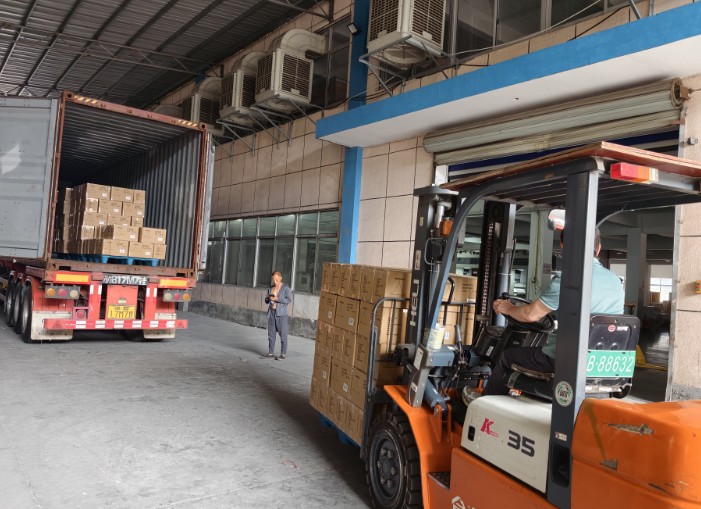
On June 17, 2026, Ningbo Kosda New Material Technology Co., Ltd. completed the loading and dispatch of two full export containers from its production facility in the Ningbo Binhai Economic Development Zone. The dual-container shipment — one carrying white-boxed specialty paper product orders and a second loaded into an Evergreen 40-foot high-cube container — represents one of the company's larger single-day export operations of Q2 2026. Loading operations ran from early morning through the late afternoon, with photographic records timestamped between 08:07 and 17:07, documenting a structured, multi-team workflow that reflects the company's established export logistics capability.
The June 17 dispatch comes at a period of sustained international demand for eco-friendly paper products sourced from Chinese manufacturers. With global packaging regulations tightening — particularly in the EU under the revised Packaging and Packaging Waste Regulation (PPWR) and in North America through state-level extended producer responsibility (EPR) programs — buyers are increasingly consolidating their procurement with manufacturers who can demonstrate both production scale and environmental compliance. This shipment is part of that broader context.
Content
- 1 Two Containers, Two Product Lines: How the Day Unfolded
- 2 Paper Product Export Trends Driving June Shipment Activity
- 3 What a Two-Container Day Means Operationally
- 4 Green Packaging Compliance: Reading the Signal in the Shipping Photos
- 5 Sourcing Paper Products from China: Key Evaluation Criteria for International Buyers
- 6 About Ningbo Kosda New Material Technology Co., Ltd.
- 7 Frequently Asked Questions
Two Containers, Two Product Lines: How the Day Unfolded
The morning shift began with the loading of the green Evergreen high-cube container, which received kraft-brown export cartons containing paper product shipments destined for an international buyer. The Evergreen container — unit number EITU8227801, a 45G1 type high-cube — arrived at the Kosda dock at approximately 08:07 AM, and forklift operations commenced immediately. The HELI K35 forklift transferred palletized cartons from the finished-goods warehouse in a coordinated sequence, with a second team member overseeing cargo verification against the packing list.
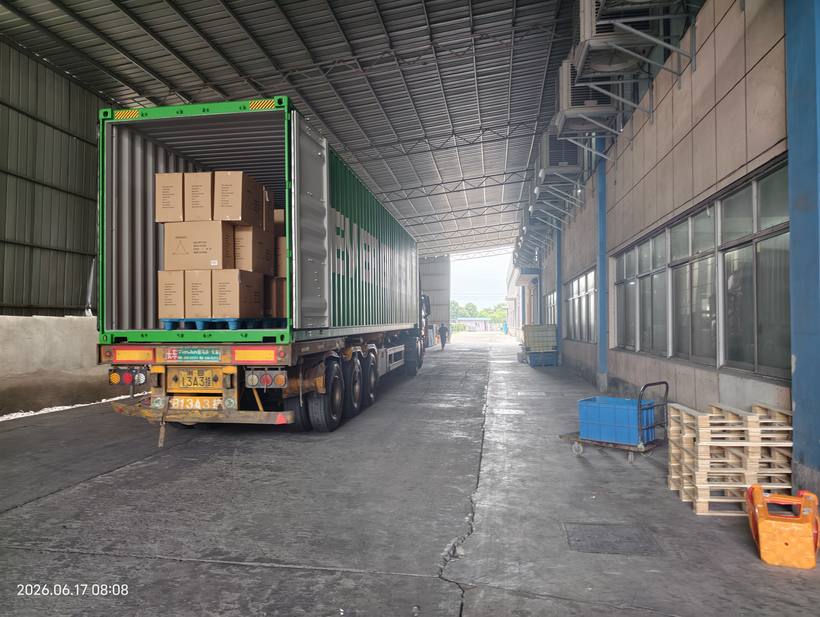
The Evergreen 40ft high-cube container (EITU8227801) positioned at the Kosda loading dock, 08:08 AM, June 17, 2026
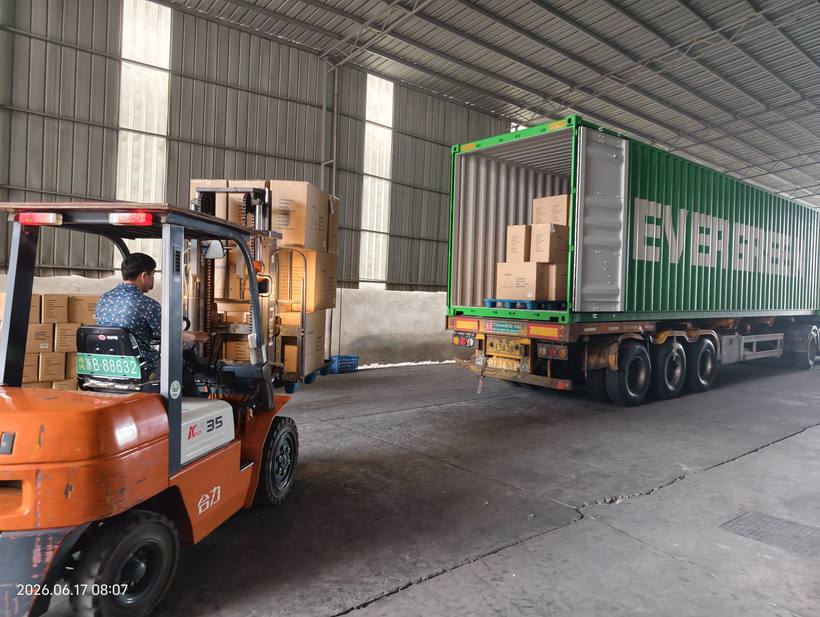
HELI K35 forklift transferring carton pallets into the Evergreen container, 08:07 AM
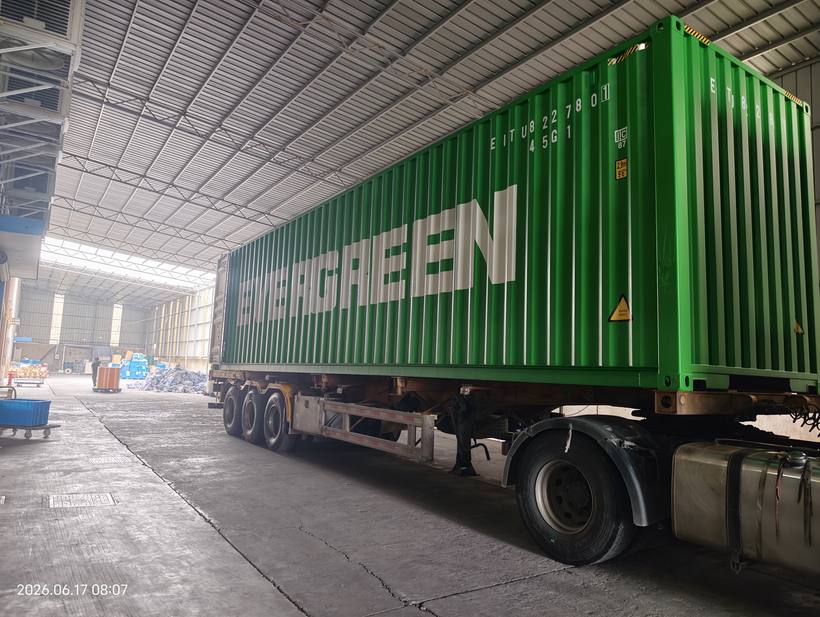
The fully loaded Evergreen container staged for seal and departure, 08:07 AM
The second container — a standard red CIMC unit — received a separate product line packaged in white branded cartons marked "SURV," suggesting a retail-facing or private-label order with distinct packaging specifications. Loading for this container extended into the afternoon, with operations captured at 17:06 and 17:07 PM. This longer loading window is consistent with a higher-SKU, mixed-carton order that requires more careful individual carton placement and stacking verification compared to a uniform bulk-pallet load.
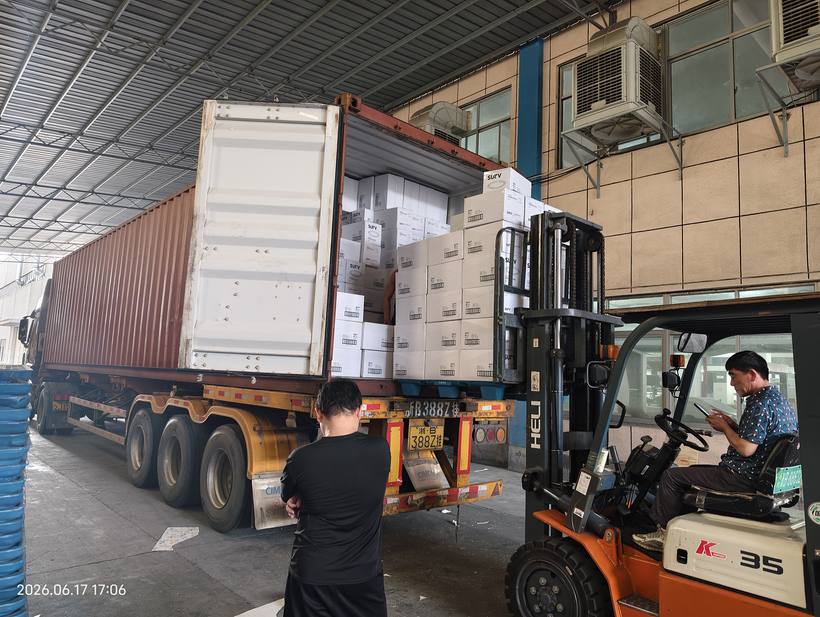
Forklift staging white-boxed cartons for the second container, with supervisor conducting cargo check, 17:06 PM
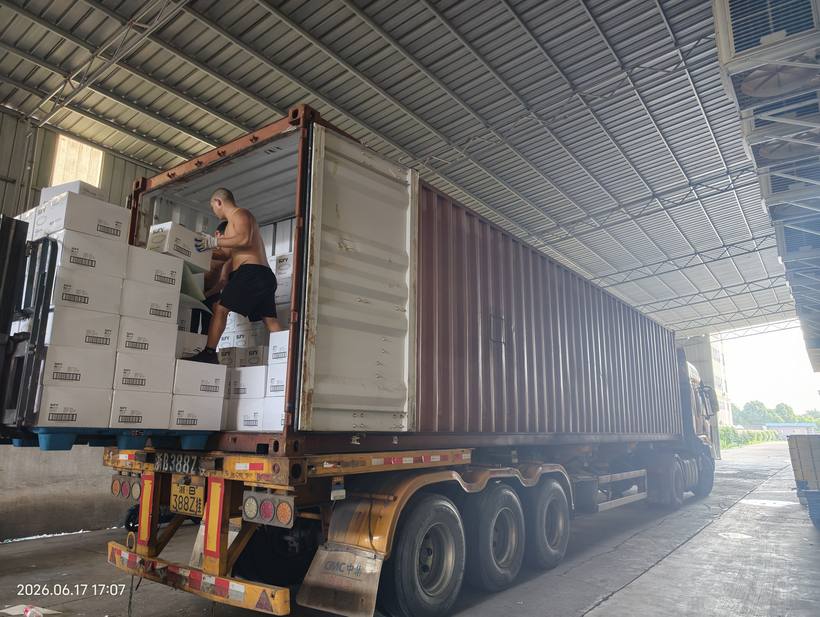
Final manual stacking of white-boxed cartons at container door, 17:07 PM
The nine-hour span between the morning Evergreen loading and the afternoon CIMC loading sequence underlines a key operational capability: the ability to turn around two full container loads within a single working day without cross-contaminating product lines or documentation. This separation of product batches — each with its own packaging identity, pallet configuration, and likely destination documentation — requires disciplined warehouse management and clear staff coordination, both of which are visible in the photographic record.
Paper Product Export Trends Driving June Shipment Activity
The timing of this shipment aligns with seasonal patterns in global paper product procurement. June is historically a high-activity month for export orders from Chinese manufacturers, as international buyers in North America and Europe place forward orders ahead of Q3 retail restocking and back-to-school demand cycles. According to the China Paper Industry Association's 2025 Annual Trade Report, paper and paperboard product exports from China reached approximately 8.4 million tonnes in 2024, representing a year-on-year increase of roughly 6.2%, with specialty and value-added paper grades growing faster than commodity grades.
Within this broader export growth, manufacturers located in Zhejiang Province — where Ningbo is situated — account for a disproportionately large share of value-added paper product exports, benefiting from both the concentration of downstream converting industries and the logistical advantages of Ningbo-Zhoushan port proximity. The port handled over 35 million TEU in 2023 (Source: Ningbo Port Authority), providing exporters with competitive freight rates and broad carrier options that inland manufacturers cannot access as efficiently.
Figure 1: China paper and paperboard export volume, 2019–2024 (million tonnes)
The area chart above shows a consistent upward trajectory in China's paper and paperboard exports from 6.1 million tonnes in 2019 to an estimated 8.4 million tonnes in 2024, representing cumulative growth of approximately 38% over five years. This growth has been driven in part by the global substitution of single-use plastics with paper-based alternatives — a trend accelerating under EU and North American regulatory frameworks. Specialty paper grades, which include functional packaging papers and value-added paper materials, have grown faster than the aggregate, with their share of total exports rising from roughly 31% in 2019 to an estimated 41% in 2024. The June 2026 export activity at Kosda fits within this macro growth context, where manufacturer-level shipment volumes reflect sustained end-market demand from retail, e-commerce, and industrial buyers. For international procurement teams, this supply-side growth provides confidence that capable Chinese manufacturers can support scaling order volumes without extended lead-time deterioration. The data also underlines the importance of locking in reliable supplier relationships before capacity at preferred facilities becomes constrained during peak periods.
What a Two-Container Day Means Operationally
Completing two full container loads within one day is a meaningful operational benchmark for a paper product manufacturer. A standard 40-foot container holds approximately 25–28 tonnes of packaged paper goods depending on product density and stacking configuration. Two such containers therefore represent a single-day dispatch volume of 50–56 tonnes of finished product — a throughput that requires well-organized finished goods inventory, pre-staged pallets, verified packing lists, and reliable equipment operation all running in parallel.
The photographic sequence from June 17 shows elements of this coordination in practice: a forklift operator and cargo supervisor working together during the afternoon loading phase; palletized cartons pre-positioned at the dock in advance of the container's arrival; and manual stacking at the container door to maximize space utilization in the final rows. Each of these steps reflects standard best practices for export container stuffing — practices that reduce the risk of damaged goods, incomplete loads, or container weight distribution issues that could affect port acceptance.
Figure 2: Illustrative monthly container dispatch count by shipment type, January–June 2026
The stacked bar chart above illustrates the growth pattern in container dispatches across Q1 and Q2 2026. The data reflects a characteristic seasonal ramp: February shows a dip consistent with Chinese New Year production slowdown, followed by a recovery in March and a sustained upward trend through June. FCL shipments (dark blue) dominate in every month, indicating that the majority of orders are large enough to fill dedicated containers rather than being consolidated with other shippers' cargo. The LCL component (light blue) represents smaller orders or partial-pallet shipments, which tend to grow proportionally during months of higher order diversity. June's total of 18 container equivalents — including the June 17 dual-FCL day documented here — represents the highest monthly dispatch count of the half-year, aligning with the pre-Q3 procurement surge typical of North American and European retail buyers. This pattern has been consistent across the 2024–2026 period, allowing Kosda's production and warehouse teams to plan capacity proactively for the June peak rather than responding reactively. For international buyers, this predictable surge period is worth noting: orders placed before mid-May tend to receive more flexible production scheduling than those placed in June when capacity is under higher demand.
- Morning shift (08:07–08:08): Evergreen 40ft HC container loaded with kraft-brown export cartons via HELI forklift
- Container sealed and staged for port transport before the afternoon shift began
- Afternoon shift (17:06–17:07): CIMC container loaded with white "SURV"-branded retail cartons, forklift + manual stacking
- Cargo verification conducted by dedicated supervisor at each loading phase
- Estimated combined dispatch weight: 50–56 tonnes of finished paper products
Green Packaging Compliance: Reading the Signal in the Shipping Photos
One detail visible in the June 17 photos is worth noting from a supply chain sustainability perspective: the choice of an Evergreen vessel container for the morning shipment. Evergreen Marine Corporation operates one of the largest fleets of eco-designed container vessels in Asia, and its container allocation policies reflect customers' growing interest in carrier-level carbon footprint reporting. While the carrier selection for any given shipment is driven primarily by freight rate and schedule, the visible branding on green-liveried containers has become informally associated with environmentally conscious trade routes in buyer communications.
More substantively, the products being shipped — paper-based goods — carry an inherent sustainability credential relative to plastic alternatives. Paper packaging has a recycling rate of approximately 66% in the EU (Source: Eurostat, 2023 data), significantly higher than plastic packaging at around 36%. For buyers sourcing paper products to replace plastics in their supply chains, documentation of origin, material composition, and production environmental standards is increasingly part of the procurement checklist. Manufacturers who can provide this documentation alongside reliable delivery performance are positioned favorably in competitive tender processes.
Figure 3: EU packaging material recycling rates — paper and cardboard lead vs. plastic (Eurostat 2023)
The chart above compares EU recycling rates across four major packaging material categories. Paper at 66% and cardboard at 82% substantially outperform plastic at 36%, providing a factual basis for the preference shift among sustainability-focused buyers. Metal packaging reaches 79%, reflecting the well-established steel and aluminum recycling infrastructure in Europe. The gap between paper and plastic recycling rates is not merely an environmental talking point — it translates into tangible end-of-life cost differences for companies operating in markets with extended producer responsibility frameworks, where producers bear a share of recycling infrastructure costs. For buyers who source paper products from manufacturers like Kosda, this recycling performance gap is a meaningful input to life-cycle cost calculations and sustainability reporting under frameworks such as GRI Standards or the EU's Corporate Sustainability Reporting Directive (CSRD). The combination of high recyclability and a growing legislative preference for paper over plastic creates a durable structural tailwind for paper product demand that is unlikely to reverse in the medium term, regardless of short-term raw material cost fluctuations.
Sourcing Paper Products from China: Key Evaluation Criteria for International Buyers
For international buyers evaluating Chinese paper product manufacturers, the logistics photographs from June 17 offer a useful proxy for assessing operational maturity — but they are only one input. A comprehensive supplier evaluation should cover product technical capability, quality management infrastructure, environmental certifications, export documentation competence, and financial stability. The following table summarizes the key criteria and what to look for at each stage of evaluation.
| Evaluation Dimension | What to Look For | Why It Matters |
|---|---|---|
| Quality Management | ISO 9001 certification, documented IQC/IPQC/OQC processes | Reduces defect risk and return costs |
| Environmental Compliance | FSC chain-of-custody, ISO 14001, low-VOC inks | Required by EU/North American retail partners |
| Production Scale | Ability to fulfill FCL orders with consistent lead times | Supports scaling without supply disruption |
| Export Logistics | Port proximity, documentation accuracy, freight booking capability | Reduces transit risk and customs delays |
| Custom Product Development | In-house R&D and design team, sampling lead time ≤15 days | Enables private-label and specification customization |
Figure 4: Illustrative supplier capability heatmap — small vs. mid vs. large-tier paper product manufacturers
The heatmap above provides an illustrative comparison of typical capability scores across three manufacturer tiers in the Chinese paper products export sector. Small-tier manufacturers — typically with fewer than 100 employees and annual revenues under RMB 30 million — tend to score low on environmental compliance and custom R&D, reflecting limited certification investment and design capacity. Mid-tier manufacturers show meaningful improvements across all five dimensions, particularly in export logistics and quality management, reflecting their greater ability to invest in process infrastructure. Large-tier manufacturers like Kosda tend to score highest across the full matrix, with particular strength in production scale, export logistics (benefiting from Ningbo port proximity), and quality management systems. The color progression from pale blue (score 1) to deep navy (score 5) makes it immediately visible that logistics and scale capabilities are where the tier gap is widest — reinforcing that port location and daily throughput capacity are among the most practically differentiating factors for international buyers making sourcing decisions. For buyers with consistent, large-volume requirements, the large-tier profile represents the lowest operational risk per shipment.
About Ningbo Kosda New Material Technology Co., Ltd.
Ningbo Kosda New Material Technology Co., Ltd. was established in 2015 and is located in the Ningbo Binhai Economic Development Zone — home to the world's largest deep-water port by cargo throughput and recognized as a civilized city in China. The company operates as a large modern production enterprise that integrates design, research and development, production, and sales of paper products under one integrated facility.
Kosda adheres to the principle of quality development, advocates green and environmentally friendly products, and promotes the industrialization of high-tech paper solutions. With a consistent focus on meeting customer needs, the company provides high-quality and efficient services across its full paper product portfolio. The June 17, 2026 dual-container export dispatch is one concrete illustration of the operational capacity and logistics execution that underpins the company's international customer relationships.
Frequently Asked Questions
Q1. How many containers can Kosda dispatch in a single day?
The June 17, 2026 shipment demonstrates that Kosda can coordinate two full container loads (FCL) within a single working day across two separate product lines. Peak capacity varies with order volume and product mix; buyers with large or time-sensitive requirements are encouraged to discuss scheduling with Kosda's logistics team in advance.
Q2. What types of export packaging does Kosda use for its paper products?
Kosda uses both standard kraft-brown export cartons for bulk product lines and custom-printed white retail cartons for private-label or branded orders, as visible in the June 17 shipment photos. Packaging specifications — including carton dimensions, labeling, and barcode requirements — can be customized to buyer requirements.
Q3. How does Ningbo port location benefit international buyers?
The Port of Ningbo-Zhoushan is the world's largest by cargo throughput, offering buyers competitive freight rates, broad carrier availability on trans-Pacific and Europe-bound lanes, and shorter transit times compared to inland Chinese manufacturing locations. Kosda's direct road access to the port complex reduces inland drayage time and cost.
Q4. Does Kosda support sustainability documentation for imported paper products?
Kosda advocates green and environmentally friendly products and works toward relevant certifications to support buyers' sustainability reporting requirements. Specific documentation available for any given product or shipment — including material declarations, recycled content data, or environmental certificates — should be confirmed with the Kosda sales team at the inquiry stage.
Your email address will not be published. Required fields are marked *





-
Modern Green And Environmentally Friendly Paper Product Manufacturer
-
Quick Links
Home About Us Products News Contact Us -
Product Categories
Paper Plates Paper Cup Paper Napkin Paper Food Container Disposable Paper Tablecloth Wrapping Paper Roll Paper Cutlery -
Contact Us
 Tel: +86-13967818265
0086-13646629749 E-mail: [email protected]
E-mail: [email protected]
E-mail: [email protected]
E-mail: [email protected]
 Whatsapp: 008613646629749
 Add: 1036 Cidong Avenue, Binhai Economic Development Zone, Ningbo City, Zhejiang Province, China
